

Sometimes, stopping to get a cup of coffee is exactly the right moment to make another father’s day. That certainly wasn’t my intention, when I stepped inside one of my local Dunkin franchises on a Saturday morning.
I couldn’t help but notice him, a father, maybe 45 years old. I was waiting for my dark roast — enough milk to muddy it up.
He was standing off to the side with a young man, large enough in size to at least be a teenager. The boy’s face, mannerisms and inability to speak words led me to believe he had Down syndrome.
The father spoke lovingly to the young man as they waited for a tray of drinks and a bag of breakfast.
We both received our orders at about the same time and headed for the exit together. I got there first and held the door open for father and son. He was holding his son’s hand with one hand, and the tray of beverages and balanced food with the other.
The father thanked me as we exited. I went left to my car. Father and son went right.
I watched the father place the food and beverage on the hood of his car so that he could open the passenger door and help his son get in and get buckled. As he did all of this, he continued his loving conversation with his son.
As he came around to the driver side, coffee and food in hand, I walked over to him.
I could tell that he was caught a little off guard. A stranger, a few inches taller than him, was coming to grab his attention. He placed the coffee tray and food inside the car and turned to me.
I had no idea what I was going to say. As the words came out over my lips, it felt like someone else was speaking for me.
“I just wanted to tell you that I see you, and the fine job you’re doing,” I said.
Immediately, I could tell by his face and his eyes that he knew exactly what I was trying to say.
He took a deep breath first. His shoulders sank a little, like he was releasing a weight. His eyes began to well up.
“Thank you,” he said, his eyes turning downward a little. “You have no idea what that means to me.”
Some inexplicable gravity pulled us together in a long embrace.
“You’re welcome,” was all I could muster softly as we held each other and then released.
“You made my day,” he said looking me in the eyes.
I nodded, and we both turned back towards the day before us.
As I got back in my car, I realized that my first instinctive steps toward that man and his son were taken nearly 45 years earlier.
My oldest brother was born 11 years before me. So when he and his wife, still in the early years of their marriage, had the opportunity of a winter weekend getaway, they planned to leave their two-month-old daughter at our house.
I told my parents we should set up Gina’s crib in my bedroom. It was the warmest room for a February evening, and at 16 years old, I was curious to see if I had what it took to be a parent someday.
I’ve written about that first 2 a.m. feeding here, and how caring for my niece lit the fire in me to one day be a father.
Looking back, I see that first late night feeding, diaper cleanup and soothing my niece back to sleep as a foreshadowing of three more strokes of fate — the conception and births of a daughter and two sons.
My three children were not supposed to be born. At least that’s what two top fertility clinics told my then wife and I after more than a year of trying to start a family.
Looking back on my life, I think these two parts of my personal history are why I have sacrificed nearly everything over more than 30 years to be the best father I can be.
Like how I placed protecting my children above everything else during my high-conflict divorce. Whenever shit hit the fan, I did my best to return to my core truth – I was blessed to have those three children, to fulfill every dream any 16-year-old boy can have about being a father. They gave me the opportunity to live the privileged moments that have defined me.
I will never forget what my attorney said to me in the front seat of her Toyota minivan, as we waited for the county courthouse to open so we could finally end three and a half of the worst years of my family’s life.
“I’ve never represented a father like you,” Jeanne told me, as we both stared out the windshield into the early March drizzle. “You stuck it out, all of those years. I’ve never met a dad willing to go through what you went through.”
Jeanne had been my attorney ten years earlier when she had recommended I file for divorce in order to get outside support so I could solve some severe issues in our home. (All of my previous efforts had failed, and Jeanne was concerned about the county getting involved with my kids if I wasn’t on the record signaling I was able and prepared to take care of them.)
Over the three and a half years of that grueling court battle, my attorney was the first person to say, albeit in different words, “I see you. You’re doing a fine job.”
Before my divorce, I had been an advocate for dads, but nothing like what I am now. And no. I’m not some “dad’s rights” zealot looking for revenge against moms. People who take the bitterness of divorce and turn to the extremes of retribution against the other gender do nothing but create more misery for their children and each other.
I have no interest in anything destructive.
Instead, I’ve tried to channel my pain (which I likely still need to process with professional help) into a positive movement to lift fathers up wherever I can. Including Dunkin’s parking lots.
Compliments build solidarity and warmth
In 1988, sociolinguist Janet Holmes published an analysis of more than 450 naturally occurring compliment exchanges. She found pronounced gender differences in who compliments whom and what those compliments achieve socially.
Compliments were much more characteristic of female interactions than male exchanges, she found, particularly as a way of establishing solidarity and interpersonal connection – something she didn’t find much evidence of in male exchanges.
Holmes believed that women were more likely to use compliments as a politeness strategy or a “social glue” designed to build solidarity and express warmth. For men, compliments were more of an evaluative judgment, a critique or grade, rather than an act of bonding.
She believed that her research supported the idea that men often view social dynamics through a frame of competition or status hierarchy, so giving unsolicited feedback can serve as an assertion of dominance or to prevent a man from stepping out of line.
Robert Herbert found similar behaviors in men and women in his 2008 research.
Janice Rees-Miller dove deeper into the topic in her 2011 study, Compliments revisited: Contemporary compliments and gender.
In her 2008 collection of data where three out of four participants were recorded in unstructured settings, Rees-Miller found that none of the young men she studied offered compliments about personality to other men, while 11 percent offered personality compliments to women.
Additionally, Rees-Miller found that “men infrequently compliment on appearance in any setting, and men almost never address appearance compliments to other men. Men are far more likely to compliment an addressee on performance, whether the addressee is male or female.”
Men just aren’t socialized to use compliments as a “social glue.” It feels awkward to us, though my anecdotal experience is that many younger men are breaking those rules.
One day, sitting in my favorite coffee shop, I saw a young man, another stranger, in his late twenties, maybe early 30s, waiting on his drink. I got up from where I was seated and walked over to him. The room was loud enough that I had to lean in to speak to him.
“Look,” I said. “I promise I’m not trying to hit on you, but I just wanted to let you know, you’re a really attractive man.”
I pulled back so we could see each other’s faces. He was beaming.
“Thank you man,” he said. “I work at it. It’s nice to hear that from another guy.”
A part of me – and apparently part of many heterosexual men – needed to assert “Hey, I’m straight.” So I thew in this:
“I always see my girlfriend and her friends complimenting each other on their hair, the way they look, something they’re wearing. We men don’t do that. I think we should. A lot more.”
“You’re right,” the young man replied. “We don’t. We should. You made my day. Thanks.”
We pulled each other in for a “bro hug,” clasped each other’s backs, and released. One last smile, and I turned away, and went back to my chair.
I recounted this exchange to a male friend of mine a few minutes later when he showed up to the coffee shop. Over the years we had known each other, he and I had talked about a lot of important topics.
His mother passing away. His father being too old to live by himself. His sister being too selfish to assist him in caring for his father. How he was attracted to his single next door neighbor, and how he was trying to understand why she had dabbled in being flirtatious with him at times, and indifferent at other times.
He’s much closer in age to me than the young man who so warmly received my compliment. But my telling that story garnered no visible reaction or verbal response.
Men need more solidarity and warmth
What a shame that some men are just too removed from the power of compliments. I know that my life has been richer on the rare occasion when a man has, unsolicited, complimented me on my character.
One of the most powerful moments happened about two years before my encounter with that father in the Dunkin’s parking lot.
Tyler, my youngest, had just graduated high school. The ceremony was over. The parking lot where it was held was nearly empty and staff was folding up the chairs, audio equipment and risers.
All three of my children were with me. This was my last high school graduation, and the bittersweet emotions of the last few hours made me want to linger there as long as I could, holding on to the hugs and joy my little family had shared in that school district over more than 20 years. They were the best years of my life.
Tom, my middle son’s varsity baseball coach was still there with another coach. I love Tom dearly because during the divorce, he supported my son emotionally when he noticed Chris was feeling down. Both coaches knew all three of my children, from all the time we spent at games and practices.
We walked over to say goodbye.
The other coach had been Tyler’s gym teacher, and he complimented my son as a fine young man.
“All three of your children are great kids Rich,” Tom said to me. “It’s a testament to the father that you are.”
Given what had been said about me in court and how some members of my community had come to support those claims about my character from local gossip, Tom’s compliment caused my whole body to flush with warmth.
This was the first time that a man who knew me and my children offered their positive opinion of the father and man they witnessed. I walked over to Tom and hugged him tight and told him “thank you.”
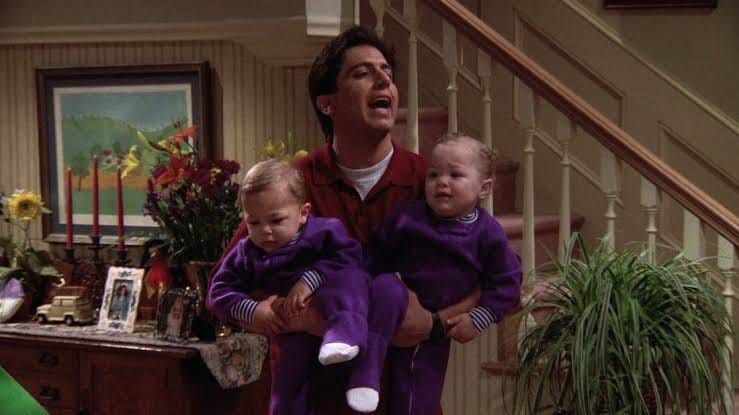
America talks shit about dads. We’re mostly seen as bumbling fools, the Ray Romano of the parent set.
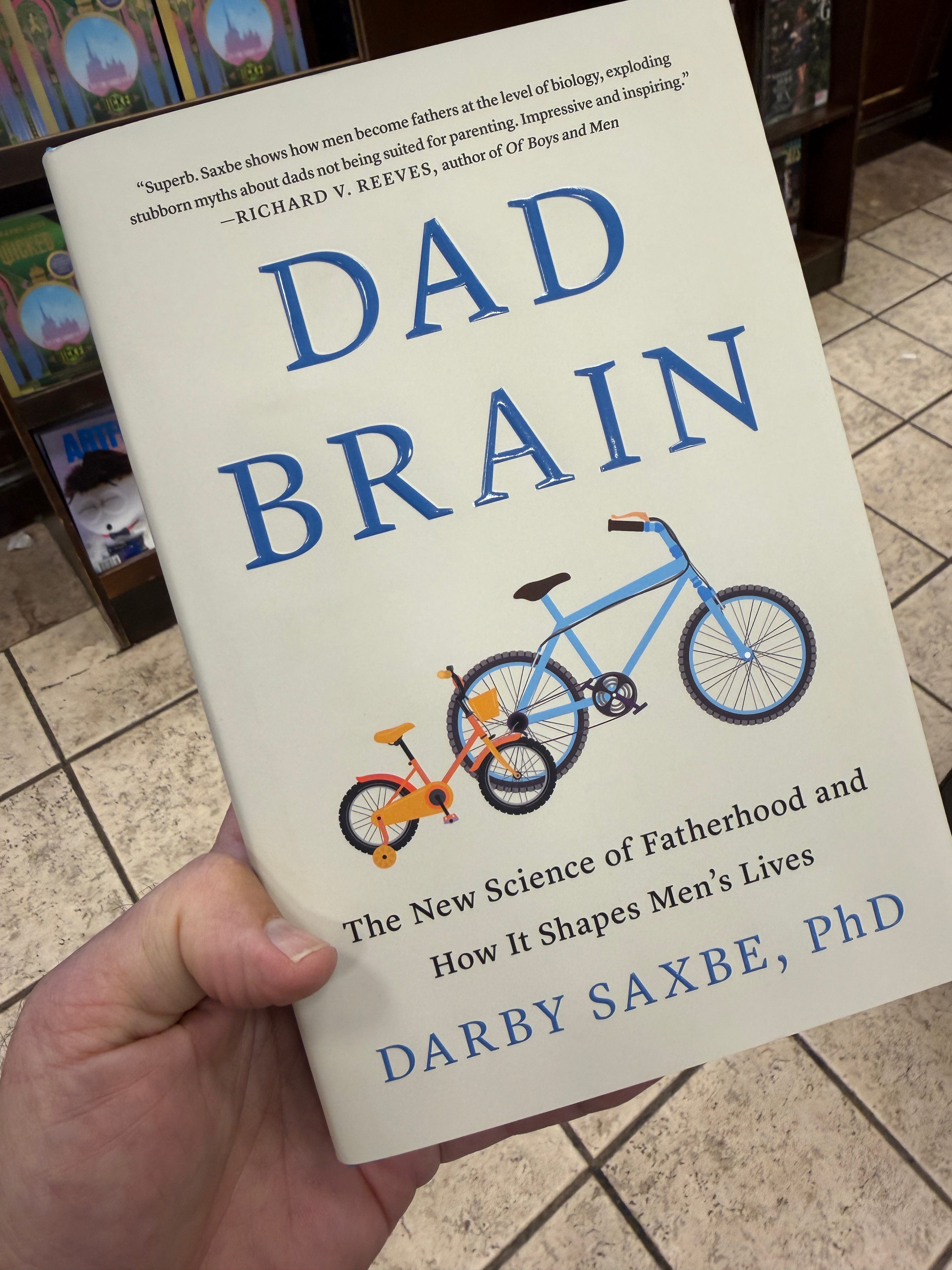
Thankfully, Darby Saxbe is documenting just how unfair and ridiculous America’s cultural presentation of fathers is.
Do we have a ways to go as parents to be better? Of course we do.
You know how we can get there faster?
Straight men need to compliment men more about their character, like what they see in a man who lovingly cares for a child with developmental disabilities… or the man who:
takes his child out for breakfast in the morning -- not to give mom a break, but because he wants “alone time” with his child
joins a group of stroller dads so that he has male friends to share his experiences with
prioritizes the hearts and minds of his children in divorce court to his own financial detriment
We straight men need to get over the homophobia that makes us fear complimenting other men in an intimate platonic friendship, and as total strangers.
We need to start now. Too much is at stake.
And who knows? You just might make another man’s day.


