


“I think we strive… to say we’re going to remove the restrictions that come from generalization, that come from saying men, women, masculine, feminine, people of color, whatever, and look for and honor the uniqueness and the individuality.” Gloria Steinem, A conversation with Richard Reeves, January 20, 2026
I had great hopes for Richard Reeves’ conversation with Gloria Steinem, especially when I thought Reeves agreed with Steinem’s desire to see humans as humans, versus humans with a gender, when he said:
“… you wrote, I think, that we’ve spent a lot of time arguing that women can do anything men can do. But we shouldn’t forget to also argue that men can do what women can do.”
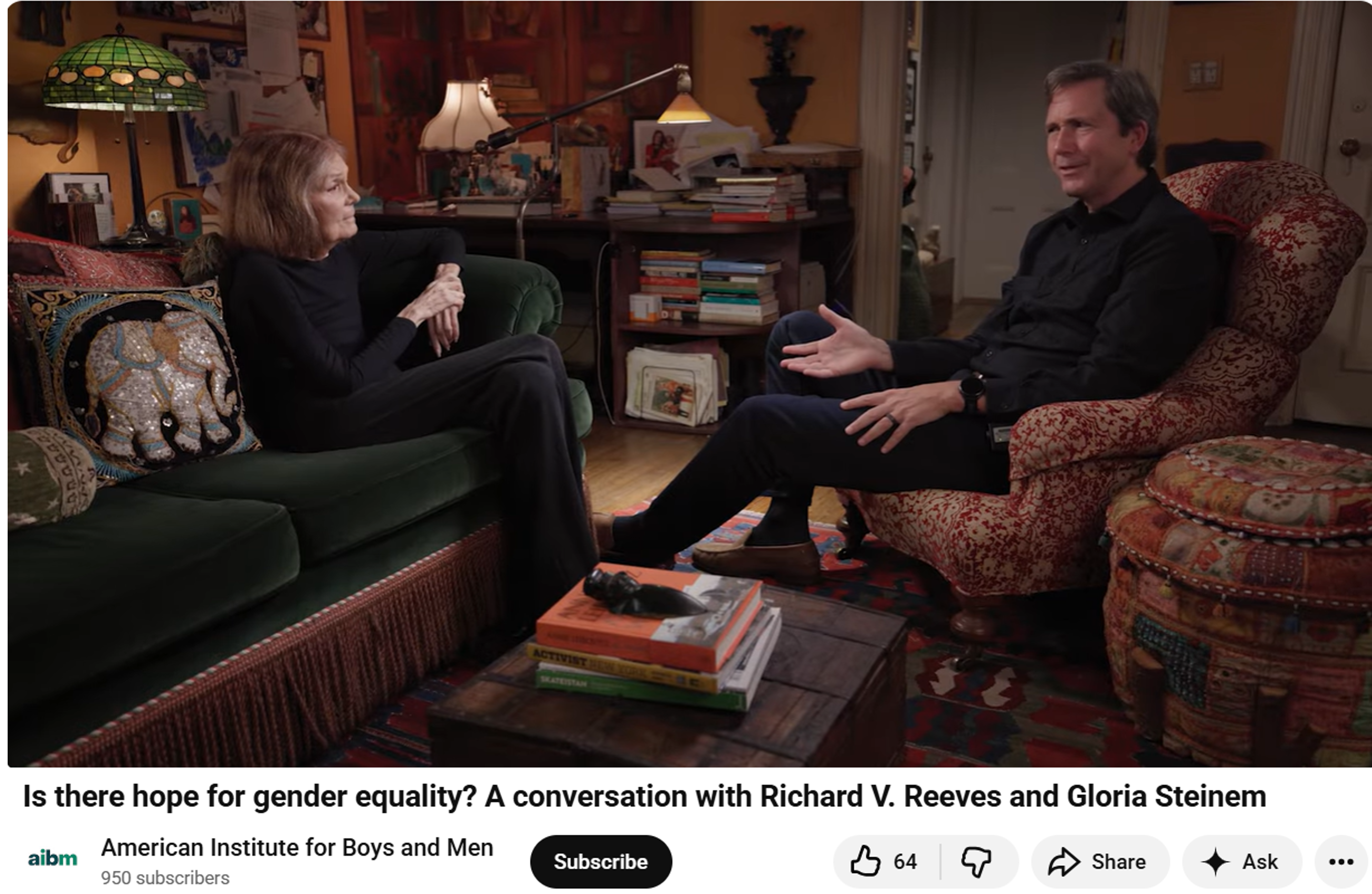
Great, I initially thought. Reeves is ready to smash gender restrictions!
As Steinem began to agree with Reeves, he spoke over her:
“Because otherwise women just have more work, right? You just expand women’s roles.”
Steinem again tried to agree with Reeves, the president of the American Institute for Boys and Men (AIBM), and one of today’s leading voices on the suffering of boys and men.
But instead of exploring how men can take some of those expanded roles off women (doing what women can do), Reeves raced off in his direction — his struggle to persuade institutions to fund programs that help boys and men enter traditionally female occupations.
Steinem offered her opinion:
“... it probably would be helpful and not that expensive to send exemplary men who can expand the boys’ ideas of what they can do.”
For better or for worse
This dynamic recurs throughout the 43-minute conversation.
Steinem makes bids to explore human wholeness and individuality. Reeves counters with traditional male stereotypes that fragment wholeness.
Like when he talked about the Hopi tradition of fathers taking children on “a long hike up the mountain… [to] show them the world that they’re going to have to go and explore.
“And that’s a particularly [a] kind of paternal role to sort of say, ‘you’re going to go out, you’re going to explore, etc.’ And I personally like that… because I think it’s quite pro-fatherhood. I think it shows there’s some difference.”
Reeves falls into the same trap when he references Sarah Blaffer Hrdy’s 2024 book, Father Time: A Natural History of Men and Babies. I haven’t read the book, but according to Reeves, it mentions Ruth Feldman’s 2009 lab experiments involving 71 mothers and 41 fathers engaging with their 4- to 6-month-old babies.
Feldman and her staff wanted to measure different types of engagement and how it affected oxytocin levels in the moms and dads.
In the Steinem interview, Reeves says women experienced an “oxytocin spike” from breastfeeding, cuddling and close physical contact. For fathers, Reeves states, the experiment showed it’s “more rough and tumble” activity that stimulates oxytocin spikes for men, like “throwing the kid in the air and catching them, or something like that.”
I’ve read Feldman’s paper – “Natural variations in maternal and paternal care are associated with systematic changes in oxytocin following parent—infant contact.”
I’m no scientist, but my understanding is the study does NOT say: “Fathers typically get oxytocin spikes from rough-and-tumble play because that’s how male biology works.”
Reeves is oversimplifying the study’s findings.
Despite his line about men being able to do what women can do, throughout the interview Reeves seeks to validate aspects of traditional male stereotypes versus following Steinem’s lead for a “total human experience.”
For example, Reeves never mentions that Hrdy’s Father Time argues that men can be biologically transformed through prolonged intimate caregiving with babies. She explicitly says fathers can show responses similar to mothers.
I believe the answer lies in the facts Reeves chooses to present and how those facts make him feel.
“I find that a beautiful finding,” he says about his interpretation of the “throwing a kid in the air” oxytocin results.
“… because… as a dad, there’s actually a danger sometimes. I think that because you don’t necessarily have the same biological connection and the same hormonal kind of reactions that there’s something wrong with you.”
We hear this sentiment again when he acknowledges how Steinem is “trying to get to a world where you’re wanting to honor people in their fullness as individuals,” but is compelled to add:
“And if on the average that means that the guys are a little bit different in our communication style, in our propensity to cry, in some of our interests, in our reproductive role, than women, that’s okay, as long as it’s not better.” (My bold face for emphasis.)
Reeves’ focus on this right or wrong, better or worse, gender comparison is quite telling, like he’s trying to minimize male shame and “father inadequacy” narratives.
It seems to me he prefers “permission-giving” biology stories over interior-work language. Instead of saying “dads may need to practice emotional attunement,” he relies on a mechanism story (hormones + play style) to offer men (and himself?) a rationale for our differences.
That fits his broader tendency to translate sensitive topics into public-facing, non-therapeutic framing. But it carries a tradeoff for the men and women listening to him — unintentionally reinforcing gender scripts (“dads roughhouse, moms cuddle”) unless someone explicitly offers a caveat (which Steinem repeatedly does).
Gender equality is also an inside job
Funny enough, Steinem wrote about and advocated for interior work in her 1992 book, Revolution from Within: A Book of Self-Esteem. The book was a lightning rod for feminist criticism, because in the eyes of many of Steinem’s peers, it appeared to divert attention away from external dynamics and potential policy changes.
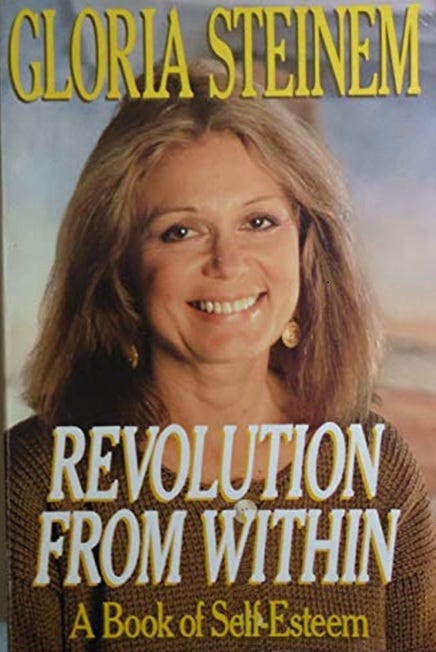
I took away two core arguments from Steinem’s book:
Role-based socialization fragments the self. Liberation reclaims a whole inner life (self-authority/self-esteem) so that people can engage the outer world unrestricted by prescribed roles.
Lasting social change is strengthened by lasting individual change. Oppression restricts people externally by teaching them to doubt self-identity.
As a co-founder and editor of Ms. Magazine (launched in 1971), Steinem provided a platform to highlight the absurdity and injustice of economic discrimination, including the inability of women to get credit cards or mortgages without a husband’s signature.
Women finally gained that hard-earned right in 1974.
In that battle for economic independence, I see an analogy for male suffering that people like Reeves seem to regularly overlook. Men aren’t born with an emotional deficit compared to women, and they are more than capable of doing the interior work that can liberate them from restrictive gender norms
It’s more like over a lifetime men grow short on emotional cashflow.
Science has proven that boys are vested with a full human emotional budget from the day they’re born. Over time, however, we teach boys, young men, and grown men to borrow from external sources, instead of investing in themselves — naming what they feel and receiving it back in care.
So, boys eventually become men flashing their Gold cards — male rules and roles. They play sports and deprioritize the arts. They purchase toughness and stoicism, while divesting themselves of the ability to cry, to ask for help, to soften.
Then the 24 percent interest and late fees kick in.
As male rules and roles compound over time, unspoken sadness becomes irritability. Unmet longing becomes numbness. Shame refinances into anger. By the time a grown man checks his statement, the principal is buried under decades of emotional debt.
And that’s the quiet tragedy: men don’t lose their feelings. They just let the world set the terms and conditions.
Men CAN do what women can do, and need to get started
For me to feel hopeful about true gender equality in the U.S., leaders like Reeves need to be more open to Steinem’s concepts about internal revolution. Too few voices in the masculinity space ever make this connection.
We saw it in Michael Kimmel’s TED Women talk, when he superficially referred to Floyd Dell’s 1914 essay, Feminism for Men. As I explained in my Bell Curve essay about Kimmel, Dell wrote at length about how his era’s norms fragmented men’s souls and undermined authentic male/female companionship.
Since then, all of the wonderful movements that moved our country forward — women’s suffrage, Title IX, the Civil Rights Act — have still left us with too many men sitting on the sidelines of the revolution.
Why?
In 1992, when Marsha Alvar spoke with Steinem about Revolution from Within on her University of Washington TV show, Steinem explained how “social justice movements” and “self-realization movements… really don’t work for very long unless they’re connected.”
If men like Reeves are truly interested in gender equality, they need to support these connections.


