

Manhood has to be continually demonstrated through socially valued achievements, and the principal achievement for most American men is the size of their paycheck.
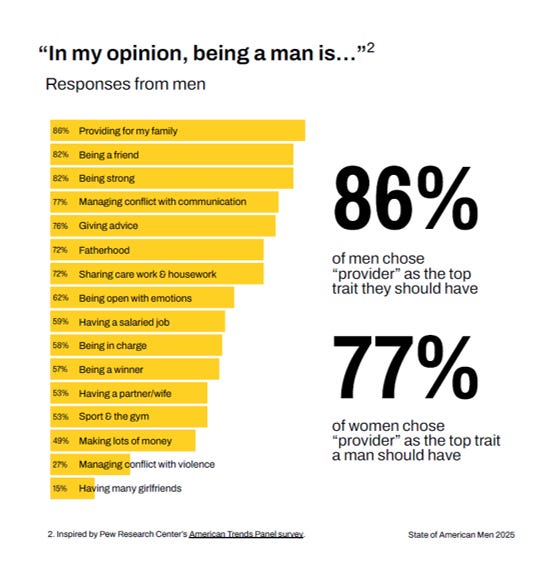
Last year, when Equimondo, a global non-profit organization seeking to promote gender equality and social justice, surveyed 2,454 men, women, and nonbinary people about topics related to masculinity, 86 percent of men chose “provider” as the top trait men should have when asked to finish the sentence: “In my opinion, being a man is…”
More than three out of four women said the same thing.
Equimondo’s research is supported by a host of other studies conducted over the last 20 years.
In 2016, a group of UConn sociologists, using 15 years of longitudinal data, concluded that as men became increasingly responsible for family income, their psychological well-being declined. Further, men who were the sole breadwinner showed lower happiness and poorer health than men in more egalitarian earning arrangements.
And worse, Equimondo reports that men who face financial instability are much more likely to consider suicide as a solution to their troubles.

That’s why I thought it was important to invite author, men’s coach, and fellow Substack writer Taylor Ashton Ellwood to talk with me about provision and masculinity.
I wanted to get to the bottom of questions like:
What happens when a man starts believing that his worth rises and falls with his income?
What happens when he loses a job, retires, gets divorced, or simply can’t provide in the ways he once could?
If his sense of self has been built almost entirely on being the provider, what remains?
Our conversation moved beyond the usual debates about who should pay for dinner or whether men should still be providers. Instead, we examined the psychological relationship men have with money itself, and why financial success has become such a powerful measure of masculinity.
We talk about how much of a man’s attachment to “Provider Masculinity” comes from our childhood, and how often men think they’re angry about money problems, when what they aren’t identifying are feelings of shame, rejection, and insecurity.
Along the way, Taylor shares stories from his coaching practice, while I reflect on my own years as the sole financial provider for my family and the pressure that role created for me.
This conversation isn’t about blaming women. It isn’t about rejecting ambition or pretending money doesn’t matter. Bills still have to be paid. Families still need stability.
It’s about asking a much deeper question:
“Who am I... if my paycheck is no longer the thing that defines me?”
In this podcast, Taylor and I cover the following:
Why so many men describe themselves as feeling like a “walking ATM.”
How the provider role became so deeply intertwined with American masculinity.
The difference between being valued for what you provide versus who you are.
How childhood experiences with financial insecurity can shape a man’s identity and relationship with money.
Why purpose, mission, and meaningful work can become a stronger foundation for self-worth than income or status.
Practical ways men can recognize when their identity has become overly dependent on provision—and begin building a healthier sense of themselves.
Why authentic communities of men may be one of the most powerful ways to discover purpose beyond the paycheck.


